Revolt
The Myth of SisyphusRevolt is the defining stance of the absurd person: not a program for changing the world, but a continuous refusal to surrender consciousness before suffering, death, or an explanation that claims to settle existence. It keeps the contradiction between human longing and an indifferent reality alive, and turns that contradiction into a demanding way of living.
Definition and Structure
Revolt begins in the clear recognition that existence does not yield the meaning the human mind seeks. Yet this recognition does not authorize escape. To abolish conscious revolt would be to evade the very problem that consciousness has uncovered. Revolt therefore means maintaining an alert confrontation between the human being and personal obscurity, insisting on an impossible transparency without converting that insistence into hope. It challenges the world anew at every moment and makes the individual permanently present to himself.
This revolt is not aspiration toward a promised resolution. It is the certainty of a crushing fate without the resignation that fate might seem to require. Its energy comes from the tension between awareness and refusal: the absurd must be contemplated precisely because turning away from it allows it to disappear as a lived problem. The result is a metaphysical revolt spread across the whole of experience, rather than a single protest directed at one isolated injustice.
Revolt and Suicide
The distinction between revolt and suicide is decisive. Suicide may appear to follow from the discovery that life is absurd, but it is not the logical outcome of revolt. It is an acceptance at the extreme, a movement toward the future of death that settles the absurd by engulfing both the absurd and the person in the same death. Revolt does the opposite. It remains simultaneously an awareness and a rejection of death, refusing to let the contradiction be resolved by disappearance.
The condemned person provides the image of this condition. At the limit of a final fall, consciousness can still fasten on a small, concrete possibility: the shoelace visible a few yards away. That remnant of perception represents the persistence of awareness even when the larger future has been closed. In this sense, the condemned person, rather than the suicide, becomes the contrary of suicide: life is maintained in the very act of facing an unavoidable end.
Revolt consequently gives life value by extending its discipline across the whole length of existence. The mind’s face-to-face struggle with a reality that transcends it becomes a spectacle of human pride. Explanations that claim to account for everything may relieve a person of the burden of carrying life, but that relief is also an impoverishment. Revolt rejects such renunciation and insists that the burden remain consciously one’s own.
Consciousness, Freedom, and Passion
Revolt is inseparable from consciousness. It is the day-to-day activity through which the absurd person refuses to mistake an invitation to death for a rule of life. The absurd yields three consequences: revolt, freedom, and passion. By remaining conscious of the condition rather than resolving it, the individual transforms an apparently negative discovery into a discipline of living.
Freedom here is not a general theory about whether humanity is metaphysically free. The question of freedom as such becomes entangled with the question of God and mastery, while the only freedom available to experience directly is one’s own. Revolt therefore does not depend on proving a universal doctrine of liberty. It begins with the limited but clear freedom of a person who refuses to surrender judgment and experience to an external final explanation.
Passion gives this freedom its intensity. The absurd person must drain experience to the bitter end, depleting himself through the effort of remaining awake to it. This is not frantic accumulation or optimism; it is the fullest possible engagement with the succession of presents before a constantly conscious soul. The movement returns from anguished awareness of the inhuman to the heart of passionate human defiance.
Revolt in Narrative and History
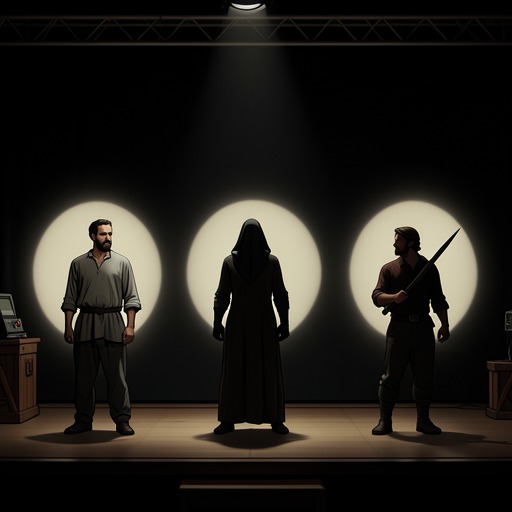
The pattern appears in the fate of Joseph K. in The Trial. He is accused without learning the charge, seeks a defense without understanding the grounds of the case, encounters lawyers who find his situation difficult, and is eventually judged in a dark courtroom. He continues to love, eat, and read his paper while the process advances around him. Later, two polite gentlemen lead him to a poor suburb, place his head on a stone, and slit his throat; his final words are, “Like a dog.”
Joseph K.’s story presents a world in which extraordinary violence is absorbed into ordinary behavior. The character treats what happens to him with a naturalness that becomes more disturbing as the events grow stranger. His failure to show sufficient astonishment at his own lack of astonishment embodies the paradox through which absurd experience becomes visible: daily gestures translate an eternal and spiritual tragedy, while institutions exercise power without supplying a comprehensible reason.
The same structure expands from the individual to history. War, tyranny, police forces, and the authorities of night turn former beauty and innocence into memory. At Tipasa, the ruins once associated with freedom are surrounded by barbed wire, accessible only through designated openings, and guarded by official restrictions. The transformation of the site becomes a material image of a world in which authority regulates movement and converts lived beauty into controlled recollection. Revolt begins when such conditions are neither denied nor accepted as morally final.
Political revolt also refuses the claim that oppression can be justified by the direction of history. Certain intellectuals on the left are described as hypnotized by force and efficacy, repeating in socialist form the realism that once served nationalism. Their different language conceals the same resignation: violence is excused because it allegedly serves an inevitable future. Revolt rejects the existence of privileged executioners and maintains that all executioners belong to the same family.
Ethical and Artistic Consequences
Revolt is not merely negation. Its ethical force lies in refusing to become an accomplice of resignation, whether resignation takes the form of suicide, metaphysical consolation, political efficacy, or silence before tyranny. Contemporary tyranny leaves no comfortable neutral position: people are compelled to stand either for or against it. Opposition is therefore not the self-appointed role of a detached witness, but an acceptance of the historical time in which one has been placed.
For the artist, revolt requires a double service to suffering and beauty. Art must not retreat into an ivory tower, but neither should it dissolve into a social church that sacrifices creation to doctrine. The artist stands among those who work and struggle, neither above nor below them. In the face of oppression, art’s vocation is to open prisons and give form to the sorrows and joys of all.
Art alone cannot produce the renewal that justice and liberty require, but without art that renewal would have no form and therefore would amount to nothing. Culture and the relative freedom it implies prevent even a supposedly perfect society from becoming a jungle. Authentic creation is thus a gift to the future, while revolt supplies the tension that keeps creation connected to human suffering rather than allowing it to become another form of escape.